The bridge
Position, identity, charts, routes, and ship time are checked where they enter the ship's systems. A false fix or an altered chart is held before navigation acts on it, and losing GPS never means believing whatever fills the gap.

The sea runs on signals. DOR proves which ones are authentic.
Ships are being walked off course by signals they cannot tell apart from authentic ones, and the rules are catching up. The last 12 months:
367,000+
ships studied by Georgia Tech researchers, who found 31 areas of ocean where GPS is persistently abnormal and at least 22 with strong evidence of large-scale spoofing.
Source: Georgia Tech study, reported October 20265 weeks
the container ship MSC Antonia sat aground in the Red Sea after a 2025 grounding attributed to GPS spoofing. The same false movements showed up in those waters 5 months earlier.
Source: Georgia Tech study, reported October 2026978,000
GPS jamming events recorded worldwide in the first 3 months of 2026.
Source: Hellenic Shipping News, June 2026100+ knots
the speed a container ship's tracking showed for a moment off the Port of Long Beach on January 29, 2026, as GPS interference spread across more than 100 miles of the approach. 7 ships reported GPS outages to vessel traffic control.
Source: gCaptain, July 2026Oct 1, 2026
the date the UK Maritime and Coastguard Agency told the maritime sector to stop relying on GPS alone.
Source: UK Maritime and Coastguard AgencyJuly 16, 2027
the deadline for covered U.S. vessels and facilities to submit an approved cybersecurity plan to the Coast Guard. Reporting cyber incidents is already required.
Source: U.S. Coast GuardA bridge plots the position it receives. A crane moves when the command arrives. A forecast is built from the buoy readings that come in. A research paper rests on the data that came back from the deployment. None of them can ask whether what they were told is authentic.
DOR answers that question for them, at the moment the data arrives and before anything acts on it. It builds to the system in front of it: the vessel, the terminal, the platform, the instrument, the lab. It runs on equipment already in place, or on a compact DOR host built for the job, works with no connection to shore, and leaves a record that cannot be edited.
Today DOR secures what is already on and under the water. Tomorrow DOR builds for it.
From the dock
to the deep.
Maritime · Open Ocean · Marine Research
Ships and ports, systems far from shore, and the science that depends on what comes back from the water.
Maritime
Every bridge, engine room, terminal, and trade document runs on data someone else sent. DOR proves it before it moves a ship, a crane, or a payment.
Position, identity, charts, routes, and ship time are checked where they enter the ship's systems. A false fix or an altered chart is held before navigation acts on it, and losing GPS never means believing whatever fills the gap.
Commands to engines, steering, and pumps, and the readings from tanks and pressure systems, are verified before they reach the machinery or the crew's screens. Updates and USB drives are checked before they touch the system.
Cranes, gates, and container release records are checked against where they started. Remote vendor access is held to what was approved, and terminal systems keep a record recovery can stand on after an attack.
Bills of lading, crew certificates, and payment and fuel orders carry proof of who issued them and that nothing changed since. A call from a cloned voice is flagged while it is happening.
Platforms, wind farms, and subsea pipelines are run over long-distance links. Every command on those links and every reading from below is verified before anyone acts on it.
The Coast Guard cybersecurity rule, IMO's cyber risk guidelines, and the classification society rules for cyber resilience on newer ships all ask owners to show what their systems acted on. DOR produces that record.
Open Ocean
Past the horizon, systems run for days or months with no link to shore. They have to know for themselves what to act on.
Uncrewed vessels and underwater vehicles work for hours, days, or months with no connection to shore. DOR checks every command on board, offline, and checks the GPS fix a vehicle takes when it surfaces, the moment it is easiest to fool.
Buoys, gliders, and floats feed forecasts, including the hurricane forecasts coastal communities plan around. DOR proves those readings were not altered on the way, and flags an instrument that was reached before recovery.
When an undersea cable or pipeline is damaged, the monitoring record and the ship tracks around it become evidence. DOR keeps both provable from the moment they are captured.
Onboard camera footage and catch logs decide quotas and compliance. DOR proves they were not changed between the deck and the reviewer.
Marine Research
Marine research is only as strong as the chain from the water to the published result. DOR keeps every link in that chain provable.
Fish and animal tracking detections move across regional research networks and partners. DOR attaches provable origin to every detection and helps separate a tag's own signal from one imitating it.
Water, eDNA, and sediment samples change hands many times before analysis. DOR records every hand-off and locks in the order things happened, so neither can be rewritten.
A sensor can sit on the seafloor for a season before anyone reads it. DOR proves the record was not changed while it waited.
Combined datasets and species identification models lose track of where their pieces came from. DOR records the source at every step and keeps unverified data out of training.
Oyster reef, seagrass, and wetland projects depend on monitoring data for permits and credits. DOR makes that data provable to the agencies and buyers who rely on it.
Nothing to rip out. No dependence on a link to shore. Every deployment starts with your systems as they are.
DOR maps what your systems receive and act on, from the antenna to the archive.
Every deployment is built to your equipment, your crew, and the rules you answer to.
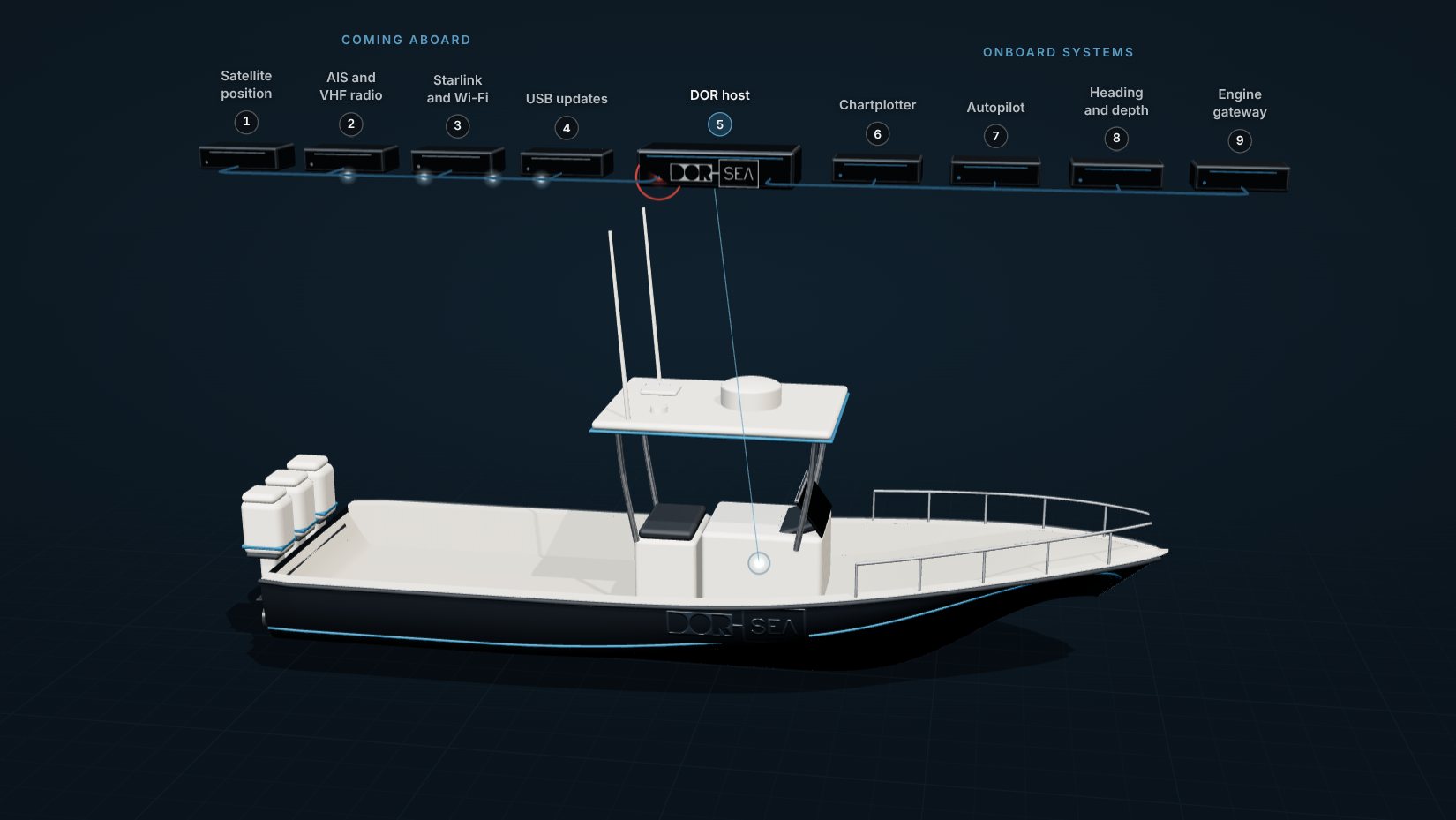
DOR runs as software on what you already operate, on board, ashore, or in the lab, fully offline. Where there is nothing suitable aboard, DOR provides a compact host built for the vessel.
You get a record of what was checked, what was held, and why. It cannot be edited.
Inside every deployment
Everything that comes aboard meets the DOR host first. Only what is proven reaches the systems that steer, power, and record the vessel. Choose a vessel to see where DOR sits.
Straight answers to what owners, operators, and research teams ask first.
Today most ships rely on the receiver's own checks and on crews noticing that something is wrong. DOR takes custody of position data where it enters the ship's systems, checks it against what the vessel can verify for itself, and holds any position that fails before navigation uses it.
Yes. DOR runs fully offline. It does not need to reach an outside server to verify anything, so protection holds far offshore and underwater.
Usually not. DOR runs as software on the systems you already operate. When a vessel has nothing suitable aboard, DOR provides a compact host built for it.
No. DOR works in front of them. Firewalls and monitoring tools decide what to do with data; DOR proves the data is authentic before they act on it.
The rule requires covered U.S. vessels and facilities to report cyber incidents immediately and to submit an approved cybersecurity plan by July 16, 2027. DOR produces a verifiable record of what your systems acted on that cannot be edited, which supports assessments, plans, and incident reports.
Yes. DOR records where each reading, sample, or detection came from and every step it passed through, so results can be reproduced and defended.
No. Every deployment is built to the system in front of it, from a single research vessel or charter fleet to a port authority.
DOR walks your systems, builds to your equipment and rules, deploys as software on what you already run, and hands you the evidence. It starts with a briefing.
And for every dock, deck, and data set above it. Start with a briefing.
Ship owners, ports, offshore operators, and research institutions: choose the Commercial & Prime Desk.
Film: underwater vehicle footage by Ifremer / Stephane Lesbats and Ifremer, CC BY 4.0, edited. Additional footage from NOAA Ocean Exploration and the Ocean Observatories Initiative. No organization named here endorses DOR.